With increasing awareness around sustainability and stricter waste management regulations in India, the demand for Organic Waste Converter (OWC) compost machines has increased significantly across apartments, hotels, restaurants, commercial complexes, educational institutions, IT parks, hospitals, and industries.
However, one of the biggest questions most organizations still have is:
What is the actual price of an Organic Waste Converter Compost Machine in India?
The answer depends on several practical factors like:
- daily wet waste generation,
- automation level,
- odor-control systems,
- installation requirements,
- maintenance expectations,
- and long-term operational efficiency
In this guide, we’ll explain:
- OWC compost machine price ranges,
- factors affecting pricing,
- how to select the correct capacity,
- common mistakes buyers make,
- operational considerations,
- and how advanced aerobic composting systems are helping organizations manage waste more efficiently.
Growing Need for Organic Waste Management in India
India generates more than 150,000 tonnes of municipal solid waste every day, and nearly 50–60% of this consists of biodegradable or organic waste.
In cities like Bangalore, Hyderabad, Chennai, Pune, and Mumbai, municipal authorities are increasingly encouraging Bulk Waste Generators (BWGs) to process wet waste at source instead of sending it to landfills.
This has led to rapid adoption of:
- Organic Waste Converter Machines
- Composting Machines
- Wet Waste Composting Systems
- Food Waste Composting Machines
- Aerobic Composting Solutions
In many apartment complexes and commercial buildings, waste transportation costs and odor complaints have also become major operational concerns. As a result, organizations are now looking for cleaner, faster, and more manageable composting solutions.
What is an Organic Waste Converter Machine?
An Organic Waste Converter (OWC) is a machine designed to process biodegradable waste such as:
- food waste,
- kitchen waste,
- vegetable waste,
- garden waste,
- hotel waste,
- and cafeteria waste.
The machine converts wet waste into compost using an accelerated aerobic composting process.
Unlike traditional open compost pits that often require large spaces and continuous manual monitoring, modern OWC machines are designed for:
- faster processing,
- cleaner operations,
- better odor management,
- and improved hygiene.
This makes them especially suitable for urban residential and commercial environments.
Organic Waste Converter Compost Machine Price in India
The price of an Organic Waste Converter Machine in India typically ranges between ₹3 Lakhs and ₹20 Lakhs+, depending on:
- machine capacity,
- automation features,
- material quality,
- odor-control technology,
- and installation scope.
Approximate OWC Machine Price Range
| Capacity | Ideal For | Approx Price Range |
| 25–50 kg/day | Small cafes, offices | ₹3 Lakhs – ₹5 Lakhs |
| 100 kg/day | Small apartments, restaurants | ₹5 Lakhs – ₹7 Lakhs |
| 200–300 kg/day | Medium apartment complexes | ₹6 Lakhs – ₹12 Lakhs |
| 500 kg/day | Hotels, large apartments | ₹12 Lakhs – ₹20 Lakhs |
| 1000 kg/day & above | Commercial projects, industries | ₹20 Lakhs+ |
Prices mentioned are approximate market estimates and may vary depending on customization, automation level, shredders, curing systems, installation conditions, and odor-control requirements.
Factors Affecting Organic Waste Converter Compost Machine Price
1. Machine Capacity
Capacity is one of the biggest factors affecting machine cost.
Larger-capacity compost machines require:
- bigger processing chambers,
- stronger motors,
- better structural support,
- and more advanced operating systems.
For example:
- A 100 kg/day machine is generally suitable for smaller residential societies.
- A 500–1000 kg/day machine is more suitable for hotels, malls, industrial campuses, or large apartment complexes.
One common mistake many organizations make is selecting insufficient capacity to reduce initial investment. However, overloaded composting systems often create long-term operational issues like odor generation, improper composting, and increased maintenance.
In most cases, choosing slightly higher capacity provides better operational flexibility.
2. Automation Features
Fully automatic composting systems generally cost more than semi-automatic systems.
Advanced systems may include:
- automatic mixing,
- moisture monitoring,
- temperature control,
- PLC-based operations,
- and smart monitoring systems.
While automated systems involve higher upfront investment, they usually reduce:
- manpower dependency,
- operational inconsistency,
- and maintenance challenges.
This becomes especially important in apartments and commercial facilities where daily manual handling may not be practical.
3. Material Quality
Material quality plays a major role in machine durability.
Industrial-grade stainless steel systems are:
- more corrosion-resistant,
- easier to maintain,
- and better suited for continuous wet-waste processing.
Many lower-cost systems use lower-grade materials that may initially appear economical but often lead to:
- faster wear and tear,
- rusting issues,
- and higher maintenance costs over time.
4. Odor-Control Technology
Odor management is one of the most critical aspects of composting operations.
In fact, odor complaints are one of the biggest reasons many apartment composting projects fail operationally after installation.
Advanced OWC systems may include:
- bio-filters,
- deodorizing systems,
- air filtration units,
- and ventilation support.
These technologies help maintain cleaner and more hygienic operations, especially in densely populated urban environments.
5. Installation & Civil Work
Many buyers only consider machine cost and overlook installation expenses.
Additional project costs may include:
- electrical setup,
- drainage systems,
- ventilation,
- platform construction,
- and compost curing areas.
Proper site planning plays an important role in ensuring efficient long-term operation.
Organic Waste Converter Machine vs Traditional Composting
| Feature | OWC Machine | Traditional Composting |
| Processing Speed | Faster | Slower |
| Odor Control | Better | Difficult |
| Space Requirement | Compact | Requires larger area |
| Automation | Available | Mostly manual |
| Hygiene Management | Easier | Challenging |
| Urban Suitability | High | Moderate |
| Operational Monitoring | Lower | Higher |
Traditional composting methods may work in low-density areas with larger open spaces. However, in urban apartment and commercial projects, automated composting systems are usually easier to manage operationally.
Which Industries Use Organic Waste Converter Machines?
Apartments & Residential Societies
Large apartment complexes generate significant wet waste daily.
Installing an OWC machine helps:
- reduce garbage transportation costs,
- improve hygiene,
- reduce dependency on external waste vendors,
- and support municipal compliance.
Many residential associations are now also focusing on compost generation for landscaping and gardening purposes.
Hotels & Restaurants
Hotels and restaurants generate large quantities of food waste every day.
Automated composting systems help:
- reduce disposal costs,
- improve sustainability initiatives,
- and maintain cleaner waste handling practices.
For hospitality businesses, odor control and hygiene are especially important considerations.
Educational Institutions
Schools, colleges, and universities increasingly adopt composting systems as part of:
- sustainability initiatives,
- green campus programs,
- and environmental awareness activities.
Commercial & Industrial Facilities
Factories, IT parks, and industrial campuses often use large-capacity composting systems for cafeteria and organic waste management.
In many cases, centralized waste processing also helps improve operational efficiency across large campuses.
Benefits of Installing an Organic Waste Converter Compost Machine
1. Reduces Landfill Waste
Organic waste contributes heavily to landfill pollution and methane emissions.
Processing waste at source significantly reduces:
- landfill dependency,
- transportation requirements,
- and environmental impact.
2. Generates Useful Compost
The compost generated can be used for:
- landscaping,
- gardening,
- agriculture,
- and urban farming.
Some organizations also use composting initiatives as part of CSR and sustainability programs.
3. Helps Meet Government Regulations
Several municipal corporations now require Bulk Waste Generators (BWGs) to process waste at source.
This commonly applies to:
- apartments,
- hotels,
- institutions,
- malls,
- and commercial campuses.
Organizations that ignore these requirements may eventually face operational and compliance challenges.
4. Reduces Waste Transportation Costs
Waste transportation becomes expensive over time, especially for large facilities.
On-site composting helps reduce:
- fuel expenses,
- collection costs,
- and external vendor dependency.
5. Improves Sustainability & Brand Image
Today, sustainability is no longer just a CSR activity.
Organizations increasingly use sustainable waste-management practices to strengthen:
- ESG positioning,
- environmental responsibility,
- and brand reputation.
How to Calculate the Right OWC Compost Machine Capacity
Selecting the correct machine starts with estimating daily wet waste generation accurately.
Basic Waste Generation Formula
On average:
- 1 household generates approximately 0.5–1 kg of wet waste daily.
However, actual waste generation may vary depending on:
- occupancy,
- food habits,
- commercial kitchens,
- and garden waste contribution.
Example Calculation for Apartments
Suppose an apartment complex has:
- 100 flats
- Average wet waste generation = 1 kg/day per flat
Then:
100 Flats × 1 kg = 100 kg wet waste/day
In this case, a 100 kg/day Organic Waste Converter Compost Machine would generally be suitable.
However, experts often recommend adding 10–20% additional capacity to handle future occupancy growth and seasonal fluctuations.
Example Calculation for Hotels
Suppose a hotel generates:
- 250–300 kg food waste daily
Then:
- a 300 kg/day composting system would typically be recommended.
Hotels with banquet operations or large kitchens may require higher capacity depending on food preparation volume.
Common Mistakes While Buying an Organic Waste Converter Compost Machine
1. Choosing Compost Machines Based Only on Initial Price
One of the biggest mistakes buyers make is selecting systems purely based on lower upfront cost.
In reality, cheaper machines may eventually lead to:
- higher maintenance,
- operational inefficiencies,
- odor issues,
- and poor compost quality.
Long-term operational performance matters more than initial pricing alone.
2. Ignoring Odor-Control Systems
Improper odor management is one of the most common reasons composting systems face resistance in apartments and commercial projects.
Good odor-control technology is critical for maintaining smooth operations.
3. Underestimating Waste Generation
Many facilities underestimate daily wet waste generation during project planning.
This often leads to:
- machine overloading,
- inefficient composting,
- and operational instability.
4. Poor Site Planning
Ventilation, drainage, electrical supply, and curing space all play an important role in composting efficiency.
Even high-quality machines may perform poorly if installation planning is inadequate.
5. Ignoring After-Sales Support
Reliable technical support and maintenance assistance are extremely important for long-term operational continuity.
Why Businesses Prefer Automated Composting Systems
Modern aerobic composting systems provide:
- faster composting cycles,
- cleaner operations,
- lower manpower dependency,
- improved odor control,
- and better process consistency.
This makes them especially suitable for urban environments where operational efficiency and hygiene are critical.
Additional Support from Vikasit Ecosystems
Vikasit also provides:
- installation support,
- waste-management consulting,
- customized machine capacities,
- maintenance assistance,
- and after-sales service support.
Why Choose Vikasit Ecosystems for Organic Waste Management?
Vikasit Ecosystems provides advanced organic waste-management solutions designed for:
- apartments,
- hotels,
- institutions,
- commercial buildings,
- industries,
- IT parks,
- hospitals,
- and municipal projects.
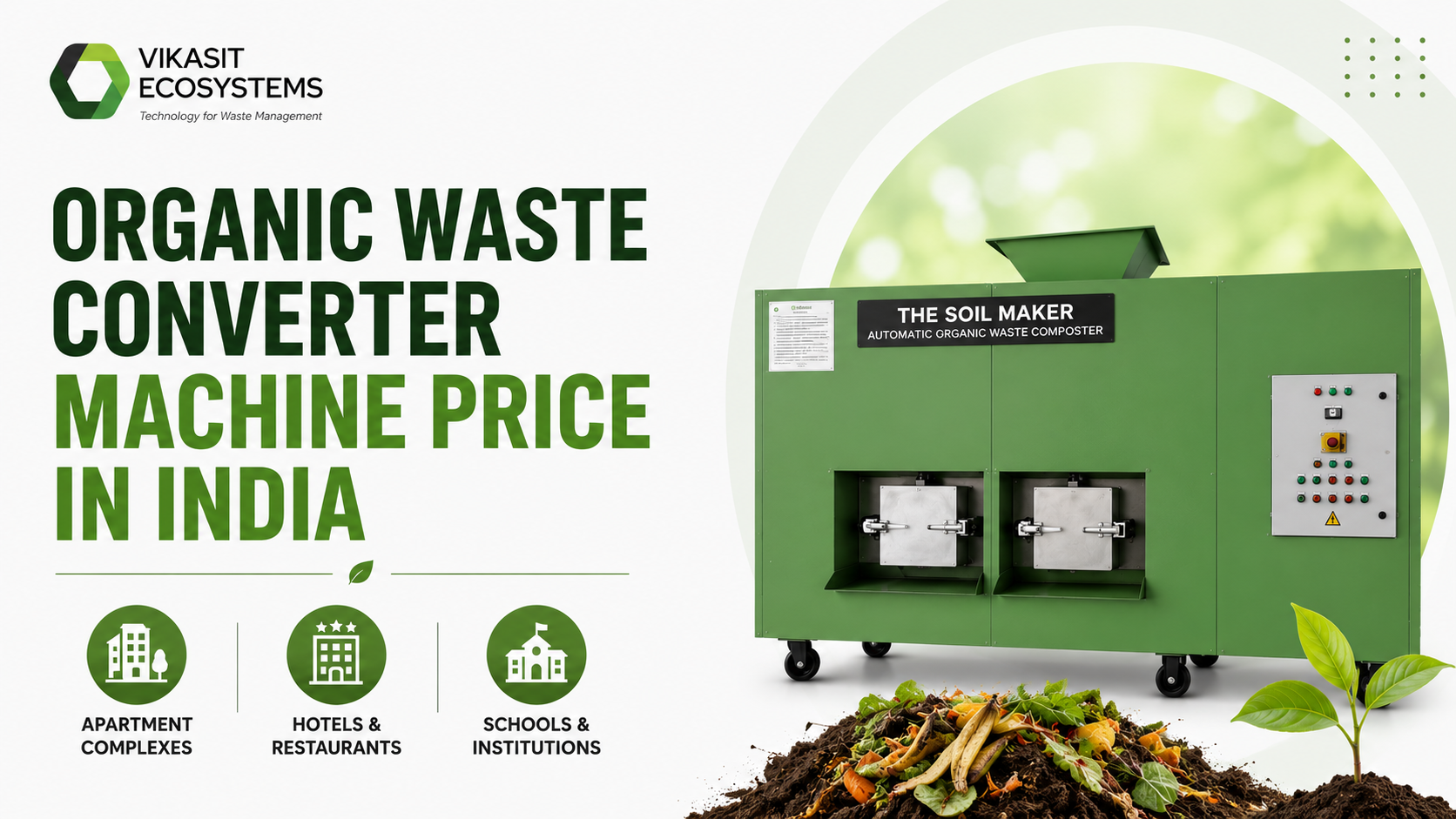
At the core of Vikasit’s waste-management ecosystem is their flagship product — The Soil Maker – Organic Waste Converter — a fully automatic aerobic composting system designed to convert organic waste into nutrient-rich compost within just 3–4 hours using Vikasit’s proprietary in-house developed bioculture technology.
Unlike many conventional composting systems that may take 24 hours to several weeks and often struggle with odor and operational inconsistency, Soil Maker is engineered for:
- rapid aerobic composting,
- odor-free operation,
- low manpower dependency,
- low power consumption,
- and compact urban installation.
One of the major operational advantages of Soil Maker is its ability to maintain cleaner and more manageable waste-processing operations even in dense residential and commercial environments where odor complaints and hygiene concerns are common.
The system is designed with:
- advanced bio-filtration,
- ventilation systems,
- PLC-controlled automation,
- moisture regulation,
- and aerobic microbial processing technology.
Soil Maker is suitable for processing capacities ranging from:
- 20–25 kg/day
to - 3 tonnes per batch,
making it ideal for:
- apartments,
- hotels,
- restaurants,
- industries,
- schools,
- hospitals,
- malls,
- and municipal waste-management projects.
Vikasit’s systems are also designed to support:
- SWM 2016 compliance,
- Pollution Control Board guidelines,
- decentralized waste management,
- and long-term sustainable operations.
Beyond machine installation, Vikasit Ecosystems also provides:
- waste-management consulting,
- installation support,
- customized machine sizing,
- AMC and maintenance support,
- operational guidance,
- and long-term after-sales assistance.
For many organizations, the challenge is not simply installing an OWC machine — it is maintaining reliable daily operations for years without odor issues, operational breakdowns, or excessive manpower dependency.
This is where Vikasit’s Soil Maker system differentiates itself by focusing not only on composting speed, but also on operational stability, hygiene, sustainability, and long-term usability.
Final Thoughts
The demand for Organic Waste Converter Machines in India is expected to grow significantly in 2026 and beyond as sustainability awareness and waste-management regulations continue to increase.
While the price of an OWC machine varies depending on capacity and features, it should be viewed as a long-term operational investment that helps:
- reduce waste-management costs,
- improve sustainability,
- support compliance,
- and reduce landfill dependency.
Choosing the right technology partner is equally important for ensuring reliable long-term composting performance and operational efficiency.
FAQs – Organic Waste Converter Compost Machine
What is an Organic Waste Converter Machine?
An Organic Waste Converter (OWC) machine converts biodegradable waste such as food waste, kitchen waste, and garden waste into compost using an accelerated aerobic composting process.
What is the price of an Organic Waste Converter Machine in India?
The price of an Organic Waste Converter Machine in India generally ranges between ₹3 Lakhs and ₹20 Lakhs+ depending on machine capacity, automation level, and additional features.
How much waste can an OWC machine process daily?
OWC machines are available in capacities ranging from:
25 kg/day
50 kg/day
100 kg/day
500 kg/day
1000 kg/day and above
Does an Organic Waste Converter Machine produce bad odor?
Modern aerobic composting systems with odor-control technologies are designed to maintain odor-free operation when properly managed.
How long does it take to process waste in an OWC machine?
Advanced composting systems can process waste within a few hours using accelerated aerobic composting technology.
Who should install an Organic Waste Converter Machine?
OWC machines are ideal for:
apartments,
hotels,
restaurants,
institutions,
industries,
hospitals,
and commercial facilities.
Is compost generated from OWC machines useful?
Yes. The compost generated can be used for gardening, landscaping, agriculture, and urban farming applications.
What is the difference between aerobic composting and traditional composting?
Aerobic composting uses oxygen-rich microbial decomposition to accelerate compost formation while reducing foul odor and improving compost quality.

Written by the Sustainability Research Team at Vikasit Ecosystems – pioneers in decentralized organic waste management and creators of The Soil Maker. Follow us for updates on green innovations, circular economy, and urban resilience.